Natasha, Pierre, and the Great Comet of 1812
Since so many Winter holidays involve finding light during the darkest days of the year, I've decided to dedicate my last advent post of 2025 to a musical about just that: Natasha, Pierre, and the Great Comet of 1812. This is really just an excuse for me to talk about one of my favorite musicals and what it, as well as the character Pierre, mean to me. In my defense, it's a very Wintery musical.
Prologue
Great Comet, one of my favorite musicals of all time, is almost comically unapproachable on paper. It is completely sung-through, with many of the songs lacking a chorus and having an irregular rhyming scheme, if one is present at all. It's also based on a less-than-100-page section of Leo Tolstoy's famous novel, War and Peace;1 some of the song lyrics are ripped directly from an English translation of the book.
A few of you may be sold on that description, but for the rest of you, I swear, it's better than it seems. It somehow manages to be some of the most fun I've ever had in a theater, and it's been a source of comfort and inspiration for me for almost two years now. If you do nothing else, at least listen to the Prologue. It'll give you a better idea of what you're in for.
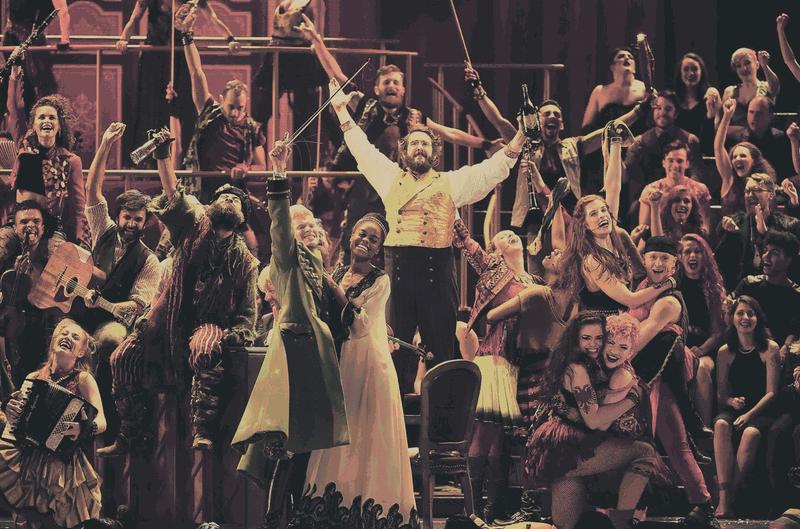
The first time I heard your voice...
The first time I saw Great Comet, I was lucky enough to see it live, knowing absolutely nothing about it. I didn't even know it was an adaptation of War and Peace until I got to the theater. It was a local college production, and I instantly became obsessed. This happens to me every once in a while -- my brain decides "this is my new thing now" and I must know everything about it.
The fact that I loved this musical so much kind of baffled me at first. I haven't historically liked stories that involve normal people doing normal things, and this was the closest thing to a slice-of-life musical I've ever seen. There was no magic or fantasy, or even a big plot. It was merely a historical drama where little got resolved by the end. It's one of those stories that you just have to experience.
It's the characters that are great, and the music is a huge part of making the characters work. The composer, Dave Malloy, has a hypnotic, almost stream-of-consciousness style to his music. It takes a lot of twists and turns that you don't see coming but make sense in hindsight. The melodies effortlessly follow the natural flow of the words' rhythm and tone. I find it very comforting.
Dear, bewildered, and awkward Pierre
Spoilers ahead. But also this story is like 150 years old.
I finally started testosterone just a few months after I saw Great Comet. Still deep into my new obsession, I decided to play the Prologue during my first injection to keep myself calm. For nearly the whole first year, I did that same thing every week. It got to the point where I could get everything prepared and injected by the time the next song, Pierre, began to play.
It feels a bit silly to say, but it felt genuinely magical. On the stage, Pierre takes a seat at his desk to explain his situation to the audience. His desk is a piano. He begins to play. He sings, it seems, what we've both been thinking:
"It's dawned on me suddenly, and for no obvious reason, that I can't go on living as I am."
This felt particularly relevant to my decision to medically transition, but it's a universal sentiment. Pierre is the everyman of the musical. Well, he's every man who's deeply unsatisfied with his life, and I'm sure everyone has been deeply unsatisfied with their life at some time or another.
Pierre is a big part of why I love this musical so much. He's complicated. Some of his behaviors and thoughts, honestly, border on incel-like at times, but he also has an immense capacity for care, which is where he ends up. The musical doesn't end with him getting with Natasha or even with him divorcing his wife who's been cheating on him. It simply ends with Pierre admiring the Comet and feeling at peace with himself and the universe.
Thanks to a song that Malloy seemingly wrote specifically for Josh Groban to sing, Pierre's arc is also pretty unusual.2 This song, called Dust and Ashes, was added to the middle of Act 1 later in the musical's life. Originally, Pierre had an uninterrupted downward slide to his lowest point at the beginning of Act 2. With Dust and Ashes, he was suddenly given a revelation in Act 1 where he vows to "wake up" and open his heart to more possibilities.
And yet, there's still Act 2. Pierre's still there writing a letter to Andrei about his wishes to be on the front lines of the war and his conspiracy theory that it's his destiny to assassinate Napoleon.3 Somehow, that inconsistency makes me like him more. People are that inconsistent, and people frequently do have to learn the same lesson over and over again before it sticks.
Pierre is a bundle of so many opposites. More than anything, though, he's both steadfast in his beliefs and deeply unsure of himself. He seems to know what a man should be, but can't name it. He doesn't know what he wants to be, but he knows it's not what he is now. Even though he and I don't share many beliefs, the way that Pierre carried himself and understood himself made me feel like I was looking into a mirror.
"It seems to me that this comet feels me,
feels my softened and uplifted soul,
and my newly melted heart now blossoming
into a new life."
Every time I try to explain why I love this musical, it never feels adequate. This is definitely the closest I've gotten to explaining it, though. If you read all that, thank you! And if I somehow convinced you to listen to it or watch it, please let me know what you think.
Happy Holidays, everyone!
Notes
I've only read Volume 1 of War and Peace, so I'm going to try to keep book characters and musical characters separate, as they're slightly different from each other. Volume 1 takes place like seven-ish years before the events depicted in the musical, anyway, but sometimes it provides some interesting context for how the characters act. It's also the source of some of my complaints about the musical (why does everyone call Pierre "old man"? He's the same age as Anatole!). All this is to say that I know some of what happens before, but I don't know what happens after the musical besides some vague spoilers I've gotten. I'm going to act as if I never heard said spoilers, and I'm treating the end of the musical as the end of the story. I'll try to stick to only the musical, but the things I know about the book characters might seep in anyway.↩
Malloy said in a Genius comment on Dust and Ashes, "I knew I had to give [Josh Groban] a proper musical theater screaming-at-the-gods moment of existential belting". The whole comment makes it seem like Dust and Ashes was written specifically because Groban was going to play Pierre when the musical hit Broadway.↩
See Dave Malloy's Genius comment on Letters for details.↩